
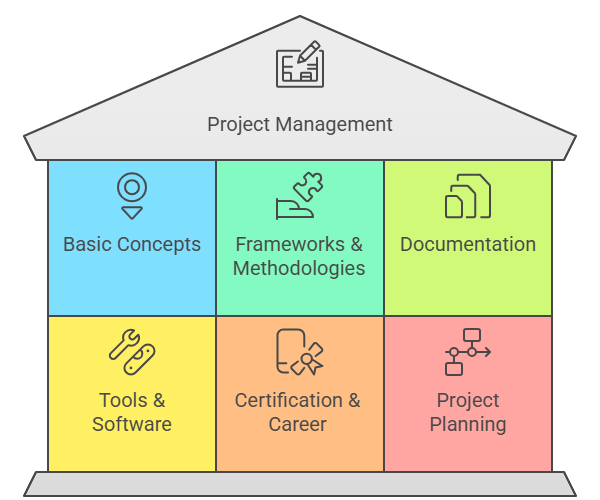

In today’s fast-moving business world, project management is the backbone of successful execution. Whether you’re building software, launching a product, or managing construction, understanding the key concepts of project management ensures that every task, resource, and stakeholder aligns toward a common goal.
This guide will walk you through the six fundamental pillars of project management — Scope, Time, Cost, Quality, Risk, and Stakeholder Management — and show you how mastering them can elevate your projects from chaos to clarity.
- Scope Management – Defining What’s In and What’s Out
Scope management defines the boundaries of your project. It ensures that everyone understands what will be delivered — and what won’t.
Key Elements of Scope Management:
- Project Scope Statement: Describes deliverables, assumptions, and constraints.
- Work Breakdown Structure (WBS): Breaks the project into smaller, manageable tasks.
- Scope Control: Prevents scope creep — those unplanned changes that can derail timelines and budgets.
Pro Tip: Always validate scope changes through a formal change control process to maintain alignment with your project goals.
- Time Management – Mastering Project Scheduling
Every successful project manager knows that time is money. Time management involves planning the sequence of tasks, estimating durations, and creating a realistic schedule.
Core Techniques:
- Gantt Charts: Visualize project timelines and dependencies.
- Critical Path Method (CPM): Identify the tasks that directly affect your completion date.
- Milestones & Deadlines: Track progress and ensure accountability.
- Cost Management – Keeping Budgets on Track
Cost management ensures your project stays financially viable from start to finish.
Phases of Cost Control:
- Estimating Costs: Forecast required resources, labor, and materials.
- Budgeting: Aggregate all cost estimates to form an approved spending plan.
- Controlling Costs: Monitor variances between planned and actual spending.
Pro Tip: Use tools like Earned Value Management (EVM) to assess performance and detect budget overruns early.
- Quality Management – Ensuring Excellence
Delivering on time and within budget means little if quality suffers. Quality management guarantees that project outcomes meet or exceed stakeholder expectations.
Three Pillars of Quality:
- Quality Planning: Define quality standards and how they’ll be measured.
- Quality Assurance: Establish processes to prevent defects.
- Quality Control: Inspect deliverables to verify they meet requirements.
Example: In a software project, quality management includes code reviews, testing, and user feedback loops.
- Risk Management – Preparing for the Unexpected
Every project faces uncertainty. Risk management identifies, analyzes, and mitigates potential issues before they become problems.
Key Steps in Risk Management:
- Risk Identification: Brainstorm possible risks (technical, financial, environmental, etc.).
- Risk Analysis: Evaluate the likelihood and impact of each risk.
- Risk Response Planning: Develop mitigation or contingency plans.
- Monitoring: Continuously track and update risk registers.
Example: A supply chain delay can threaten your timeline — having backup vendors can minimize disruption.
- Stakeholder Management – Building Strong Relationships
No project succeeds in isolation. Stakeholder management focuses on understanding and satisfying the needs of everyone involved — from clients to team members.
Steps for Effective Stakeholder Engagement:
- Identify Stakeholders: List all individuals or groups affected by the project.
- Analyze Influence and Interest: Prioritize stakeholders based on their power and impact.
- Communicate Regularly: Provide updates and manage expectations transparently.
Pro Tip: Use stakeholder mapping to ensure that communication strategies align with influence levels.
Why These Concepts Matter
Balancing scope, time, cost, quality, risk, and stakeholders is like juggling six balls at once. Neglect one, and the rest may fall. These elements form the foundation of the Project Management Triangle, which helps managers make informed trade-offs and maintain equilibrium throughout the project lifecycle.
Conclusion
Mastering the basics of project management isn’t just about tools or certifications — it’s about building a mindset of strategic planning, proactive control, and continuous improvement. By understanding these six key concepts, you can transform project uncertainty into success stories.
Project Management — Plan, Execute, and Deliver with Confidence


Pingback: Project Management Frameworks & Methodologies: Agile, Scrum, Kanban, Waterfall, PRINCE2, and PMBOK Explained
Pingback: Frameworks and Methodologies – Agile, Scrum, Kanban, Waterfall, PRINCE2, PMI/PMBOK