

Artificial Intelligence (AI) is transforming industries — and now it’s set to revolutionize India’s education system. The Central Board of Secondary Education (CBSE), under the Ministry of Education (MoE), has announced plans to integrate AI and Computational Thinking (CT) into the curriculum starting Class 3 from the 2026–27 academic year. This move aligns with the National Education Policy (NEP) 2020, which envisions equipping students with 21st-century digital skills. But like any major educational reform, it comes with its own set of strengths, weaknesses, opportunities, and threats. In this blog, we’ll conduct a comprehensive SWOT analysis of AI in education in India, focusing on the CBSE’s latest initiative — with SEO-rich insights and keywords like AI in education India, CBSE AI curriculum Class 3, and AI in school curriculum 2026 to help your post rank higher in search results.
Strengths: Pioneering a Future-Ready Generation
1.1 Early Exposure to Emerging Technologies
By introducing AI from Class 3, CBSE ensures that children gain foundational digital literacy early on. Students will learn not just how to use technology, but also how technology thinks — developing analytical and computational skills from a young age.
1.2 Alignment with NEP 2020 & Skill-Based Learning
The decision perfectly aligns with India’s NEP 2020 vision of experiential and competency-based education. It promotes a shift from rote learning to creativity, innovation, and problem-solving.
1.3 Empowered Teachers and Modern Pedagogy
With proper training under initiatives like NISHTHA, teachers can evolve into facilitators of tech-driven learning. This reform encourages educators to integrate AI tools, gamification, and digital storytelling into classrooms.
1.4 National Digital Literacy Mission Support
CBSE’s AI curriculum supports broader initiatives like Digital India and Skill India, helping to create a digitally empowered society from the ground up.
Weaknesses: Implementation Challenges and Digital Gaps
2.1 Unequal Infrastructure Across Schools
While urban schools may adapt quickly, rural and government schools could struggle due to limited access to computers, reliable internet, and AI tools. This digital divide risks creating inequalities in AI literacy.
2.2 Limited Teacher Training and Awareness
Introducing AI from Class 3 demands massive teacher upskilling. With over a million teachers under CBSE, ensuring consistent quality training and understanding is a major hurdle.
2.3 Age Appropriateness and Cognitive Load
Designing AI modules that are engaging yet simple enough for 8–9-year-old students is challenging. If not carefully designed, lessons could feel too abstract or technical for young minds.
2.4 Resource Dependency and Costs
Schools may face challenges in funding equipment, software, and maintenance. Without continuous support, AI education risks becoming another under-resourced initiative.
Opportunities: Building India’s AI-Driven Future
3.1 Nurturing India’s Next Generation of Innovators
Early exposure to AI can spark curiosity and inspire innovation among students. By Class 12, these learners could already be developing simple algorithms, chatbots, and ethical frameworks around technology.
3.2 Boosting India’s Global Competitiveness
India aims to be a global AI powerhouse. Introducing AI in education helps build a skilled workforce aligned with future job markets — from robotics to data science and automation.
3.3 Public-Private Partnerships and EdTech Growth
CBSE’s AI integration opens doors for EdTech companies, startups, and industry leaders to collaborate with schools. Companies like Intel, Microsoft, and IBM already offer AI toolkits for education.
3.4 Promoting Ethical and Responsible AI Learning
Students will learn about bias, fairness, and responsible AI usage — shaping socially aware digital citizens. This helps India build a future generation that values both innovation and ethics.
Threats: Risks and Long-Term Uncertainties
4.1 Rapidly Changing Technology
AI evolves fast. Without regular curriculum updates, lessons may become outdated quickly. A lack of dynamic policy updates could reduce the curriculum’s relevance.
4.2 Socioeconomic Inequality and Access Issues
Students in remote or underfunded schools may lag behind peers in private institutions, deepening the digital divide and social inequality.
4.3 Over-Reliance on Technology
Excessive dependence on digital tools could reduce creativity and human interaction, especially in early childhood education.
4.4 Data Privacy and Cybersecurity Risks
Introducing AI tools in classrooms means handling student data. Without robust cybersecurity measures, schools could face privacy and ethical issues.
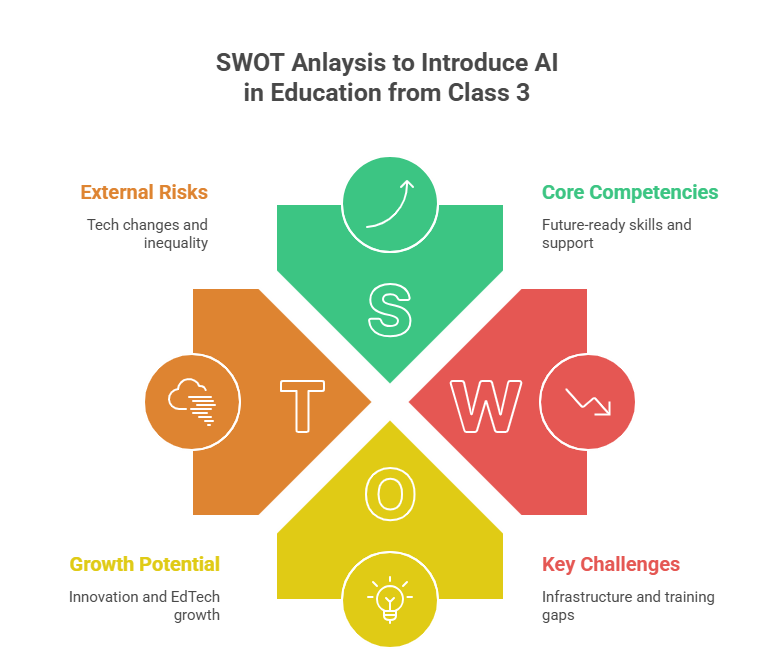
SWOT Summary Table
| Aspect | Highlights |
| Strengths | Future-ready skills, NEP alignment, teacher empowerment, policy support |
| Weaknesses | Uneven infrastructure, lack of training, high costs, cognitive challenges |
| Opportunities | Innovation culture, job readiness, EdTech growth, ethical learning |
| Threats | Fast tech changes, inequality, over-reliance, privacy concerns |
Conclusion: A Bold Step Toward Digital India’s Future
CBSE’s initiative to introduce AI in education from Class 3 marks a historic leap in India’s academic evolution. If implemented effectively—with teacher training, infrastructure upgrades, and inclusive access—this could empower millions of students with skills for the AI-driven future.
However, to succeed, India must bridge its digital divide, maintain ethical standards, and ensure continuous curriculum updates. Done right, this move can transform India’s students from passive consumers of technology to innovative creators shaping the AI revolution.


Pingback: AI in Education from Class 3 Marking a Historic Leap in India’s Learning Landscape