
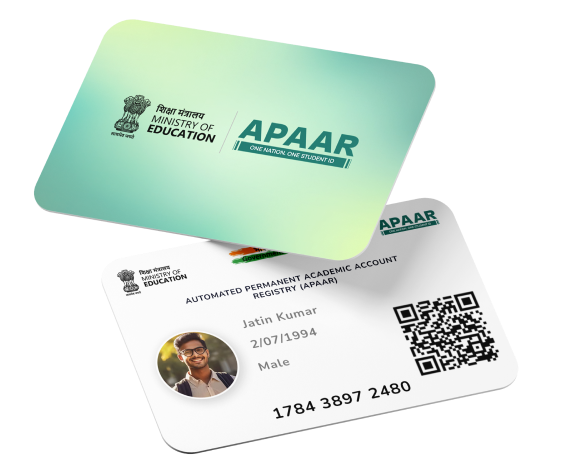

What is the APAAR Card?
The APAAR (Automated Permanent Academic Account Registry) card is part of the Government of India’s visionary “One Nation, One Student ID” initiative, aligned with the National Education Policy 2020 (NEP 2020).
It aims to give every student in India a unique 12-digit academic ID that stays with them throughout their educational journey — from school to higher education and beyond.
Key Highlights of the APAAR Card:
- Every student receives a 12-digit unique APAAR ID.
- This ID links to a digital profile storing academic credits, certificates, co-curricular activities, and achievements.
- It serves as a lifelong academic identity, enabling portability and easy verification of student credentials.
In simple terms, the APAAR card acts as a digital academic passport, ensuring that every student’s learning journey is stored securely and can be accessed anytime, anywhere.
Why the APAAR Card Matters
The introduction of the APAAR Card addresses several long-standing issues in India’s education system:
- Consolidated Academic Records : Students often struggle with fragmented records while changing schools or universities. APAAR solves this by consolidating all educational data under a single, permanent ID.
- Credit Portability and Flexibility : Linked to the Academic Bank of Credits (ABC), APAAR enables students to easily transfer credits between institutions — supporting NEP 2020’s vision of flexible learning and multiple academic pathways.
- Reduced Fraud and Verification Delays : APAAR’s digital verification reduces fake certificates and streamlines record verification for universities and employers.
- Student Empowerment : Students gain direct access to their verified academic data, helping them make better career and education decisions.
Eligibility & Registration for APAAR Card
The APAAR system is open to all students, from school level to higher education institutions across India.
For School Students
- Schools initiate registration via the official portal.
- Parent/guardian consent is required for minors.
- Identity verification happens through Aadhaar-linked mobile or DigiLocker.
- Once verified, the student’s APAAR ID is generated.
For Higher Education Students
- Students can self-register via the official APAAR portal or through their institution.
- Verification is done via Aadhaar/DigiLocker.
- Fill in academic and institutional details to generate your APAAR ID.
Prerequisites for Registration
- A valid Aadhaar number or alternative government ID.
- Correct demographic details (name, date of birth, etc.) matching academic records.
- Access to an active DigiLocker account for document integration.
Key Benefits of the APAAR Card
The APAAR initiative is a major leap toward a digitally unified education ecosystem. Here’s what makes it so impactful:
✅ Lifelong Academic Identity: Your APAAR ID remains valid throughout your education and professional life.
✅ Single Source of Truth: Consolidates all academic achievements, skill certificates, and credits.
✅ Easy Credit Transfer: Supports smooth inter-institutional movement via the Academic Bank of Credits.
✅ Paperless Record-Keeping: Reduces dependency on physical documents and prevents record loss.
✅ Institutional Efficiency: Streamlines administrative tasks, record-keeping, and analytics for schools and universities.
Challenges & Implementation Status
While the vision behind the APAAR Card is transformative, the rollout has faced some practical challenges:
- ⚠️ Slow Implementation: As of late 2024, some states reported less than 40% completion of student registrations. (Source: Live Hindustan)
- ⚠️ Data Accuracy Issues: Mismatched data across Aadhaar and school records can delay ID generation.
- ⚠️ Consent Delays: Lack of parental awareness and pending consent forms in schools. (Source: Amar Ujala)
- ⚠️ Digital Divide: Limited internet access in rural areas affects registration speed.
- ⚠️ Data Privacy Concerns: Ensuring encrypted storage and consent-based data sharing remains crucial.
Steps for Students & Parents: How to Get Your APAAR ID
Follow these steps to register and activate your APAAR Card:
✅ Confirm that your school/college is part of the APAAR registration drive.
✅ Verify your personal details — name, date of birth, and Aadhaar linkage.
✅ Visit the official APAAR portal.
✅ Log in using your DigiLocker or Aadhaar credentials.
✅ Complete the registration and download your digital APAAR ID card.
✅ Keep your profile updated as you earn new certificates or credits.
✅ For any errors, contact your institution’s administration or the APAAR helpdesk.
Conclusion
The APAAR Card is more than just a student ID — it’s a step toward a digitally empowered education system where every learner’s achievements are recognized, portable, and secure.
While challenges remain in implementation, the long-term benefits for students, parents, and educational institutions are undeniable. By embracing APAAR, India moves closer to a transparent, flexible, and future-ready education ecosystem.
FAQs About APAAR Card
- What is the full form of APAAR?
APAAR stands for Automated Permanent Academic Account Registry. - Is the APAAR card mandatory for all students?
Currently, it is being gradually implemented and encouraged by the Government of India under NEP 2020. - Can I register for APAAR without Aadhaar?
Aadhaar is the preferred mode of verification, but alternate ID linkage options may be available through your institution. - How is the APAAR ID different from DigiLocker?
DigiLocker stores documents, while APAAR acts as a permanent academic identity, integrating and verifying all your educational achievements. - What is the official website for APAAR registration?
Visit apaar.education.gov.in or contact your school/institution for guidance.
✅ Recommended Read: National Education Policy 2020 – Key Highlights and Reforms