
IaaS: Infrastructure as a Service – The Backbone of Cloud Infrastructure
In the era of cloud computing, businesses are seeking efficient ways to manage IT resources without heavy upfront investment. IaaS (Infrastructure as a Service) is a cloud solution that provides scalable cloud infrastructure, allowing organizations to deploy applications, store data, and manage networks without maintaining physical servers.
What is IaaS?
IaaS, or Infrastructure as a Service, is a cloud computing model that delivers virtualized computing resources over the internet. Unlike traditional IT setups, businesses do not need to buy and maintain physical servers or data centers. Instead, they can rent computing power, storage, and networking from an IaaS provider.
In simple terms, IaaS provides cloud infrastructure that forms the foundation for modern IT operations, enabling businesses to focus on growth, development, and innovation rather than hardware management.
Key Components of IaaS
An effective IaaS platform typically includes:
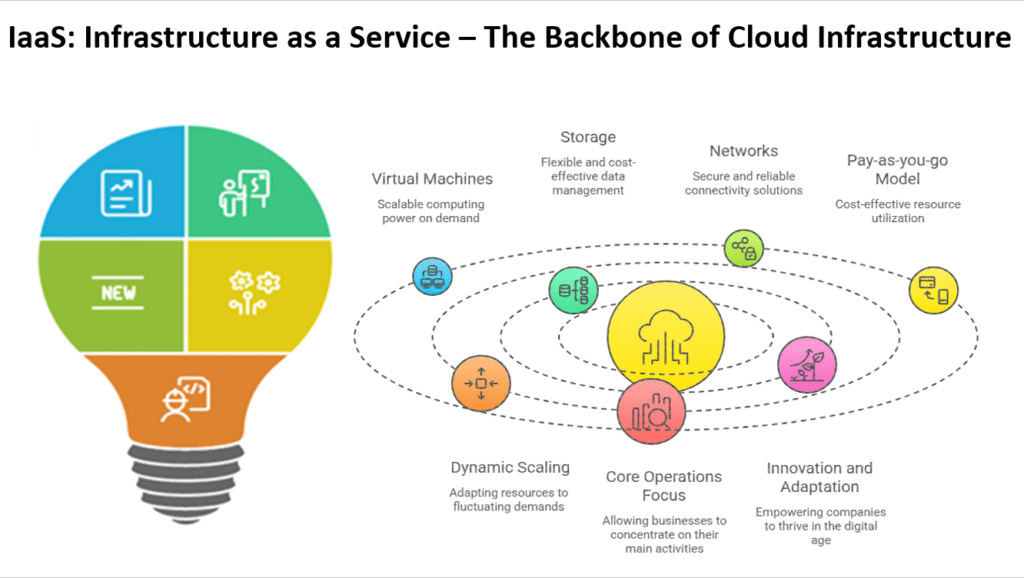
- Compute: Virtual machines (VMs) to run applications and services
- Storage: Scalable options like block storage and object storage
- Networking: Virtual networks, load balancers, and firewalls
- Management Tools: Backup, monitoring, and disaster recovery solutions
By leveraging these components, businesses can replicate an entire IT infrastructure in the cloud efficiently and securely.
Benefits of IaaS in Cloud Computing
- Cost Efficiency
With IaaS, businesses avoid upfront investments in physical servers and data centers. Pay-as-you-go pricing ensures companies pay only for what they use. - Scalability
IaaS allows organizations to scale resources up or down based on demand, making it ideal for variable workloads and seasonal traffic spikes. - Speed and Agility
Provisioning cloud infrastructure is fast, enabling rapid development, testing, and deployment of applications. - Enhanced Disaster Recovery
Most IaaS providers include backup and disaster recovery options, ensuring business continuity in the event of system failures.
Popular IaaS Providers
Leading IaaS platforms include:
- Amazon Web Services (AWS): Elastic Compute Cloud (EC2) and S3 storage
- Microsoft Azure: Virtual machines, storage, and integrated networking solutions
- Google Cloud Platform (GCP): High-performance compute and scalable storage
- IBM Cloud: Enterprise-grade hybrid cloud infrastructure
These providers deliver robust cloud infrastructure that can power everything from small applications to enterprise-grade systems.
Use Cases of IaaS
- Web Hosting: Host websites and applications without investing in physical servers.
2. Development & Testing: Quickly create test environments for software development.
3. Big Data & Analytics: Run large-scale data processing on scalable cloud infrastructure.
4. Disaster Recovery: Replicate IT systems in the cloud for faster recovery during outages.
Challenges of IaaS
While IaaS offers numerous advantages, organizations should consider potential challenges:
- Security Risks: Businesses must ensure proper access controls and data protection.
- Management Complexity: Skilled IT staff is needed to manage virtual environments.
- Unexpected Costs: Without monitoring, pay-as-you-go billing can lead to higher costs than anticipated.
Why IaaS is Essential for Modern Cloud Computing
IaaS (Infrastructure as a Service) is the backbone of modern cloud computing. It provides flexible, scalable, and cost-effective cloud infrastructure that allows businesses to innovate faster and reduce IT overhead.
From startups to enterprises, leveraging IaaS ensures efficient resource utilization, rapid deployment, and robust disaster recovery—making it an essential component of any cloud strategy.
Cloud Computing : IaaS, PaaS, SaaS, Cloud Migration, and Cloud Security
🌐Cloud Computing Trends to Watch: October 2025 Update


Pingback: SaaS: Software as a Service – The Future of Cloud Computing
Pingback: PaaS: Platform as a Service – Accelerating Innovation in Cloud Computing
Pingback: Cloud Computing : IaaS, PaaS, SaaS, Cloud Migration, and Cloud Security