
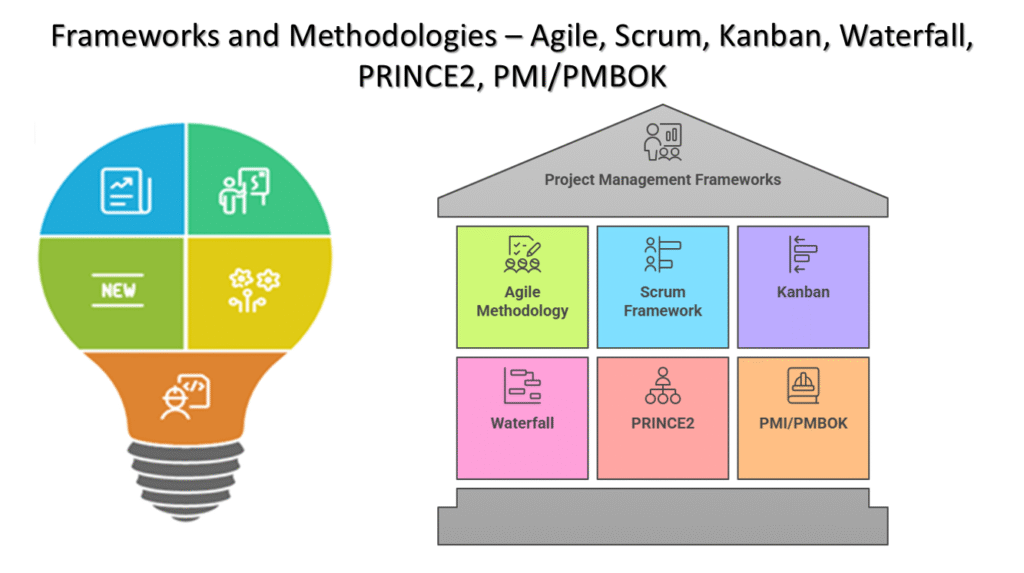

Frameworks and Methodologies – Agile, Scrum, Kanban, Waterfall, PRINCE2, PMI/PMBOK
In today’s fast-paced digital world, project management is no longer optional—it’s essential. Whether you’re a tech startup, an IT service provider, or a multinational enterprise, choosing the right project management framework or methodology can be the difference between success and failure. In this article, we’ll explore the most widely used methodologies in the industry—Agile, Scrum, Kanban, Waterfall, PRINCE2, and PMI/PMBOK—and help you decide which one fits your project and team best.
Agile Methodology – The Foundation of Modern Project Management
Agile is more than just a framework—it’s a mindset. Rooted in the Agile Manifesto (2001), this approach prioritizes flexibility, collaboration, and customer satisfaction. Instead of rigid planning, Agile promotes adaptive planning and iterative progress.
Key Features of Agile:
- Iterative development cycles (sprints)
- Continuous feedback and improvement
- Close collaboration between cross-functional teams
- Rapid response to change
Benefits: Faster delivery, higher customer satisfaction, and improved team collaboration.
Best for: Software development, product design, and startups needing quick adaptation.
Scrum Framework – Structure Within Agility
Scrum is one of the most popular Agile frameworks, designed to deliver complex projects efficiently. It divides work into short cycles known as sprints (typically 2–4 weeks).
Core Components:
- Roles: Product Owner, Scrum Master, and Development Team
- Artifacts: Product Backlog, Sprint Backlog, and Increment
- Events: Sprint Planning, Daily Scrum, Sprint Review, and Retrospective
Scrum encourages accountability, continuous improvement, and transparency. Teams self-organize and regularly review progress, ensuring the final product meets user expectations.
Best for: Software teams working in dynamic environments with frequently changing requirements.
Kanban – Visualizing Workflow for Maximum Efficiency
Kanban focuses on visual management of tasks and limiting work in progress (WIP). Using a Kanban board, teams can easily track progress and identify bottlenecks.
Principles of Kanban:
- Visualize workflow
- Limit work in progress
- Manage flow and optimize efficiency
- Implement continuous improvement
Kanban provides flexibility without overhauling existing processes, making it a favorite for teams transitioning to Agile practices.
Best for: Support teams, IT operations, and ongoing project environments.
Waterfall – The Traditional Linear Approach
Before Agile, there was Waterfall—a sequential project management model where each phase must be completed before the next begins. Common in engineering and construction, it’s best suited for projects with fixed requirements and well-defined deliverables.
Phases of Waterfall:
- Requirement analysis
- System design
- Implementation
- Testing
- Deployment
- Maintenance
Advantages: Clear structure, easy progress tracking, and predictable outcomes.
Drawbacks: Rigid and less adaptable to change.
Best for: Government, manufacturing, and large-scale infrastructure projects.
PRINCE2 – Controlled and Structured Project Governance
PRINCE2 (Projects IN Controlled Environments) is a process-based methodology widely adopted across the UK and Europe. It focuses on governance, control, and defined roles.
Core Principles:
- Defined business justification
- Clear organizational structure
- Product-based planning approach
- Manage by stages and exceptions
PRINCE2 ensures accountability and minimizes risk through strict documentation and monitoring.
Best for: Large organizations and public sector projects needing formal project governance.
PMI/PMBOK – The Global Standard
The PMI’s PMBOK (Project Management Body of Knowledge) is not a methodology but a comprehensive guide outlining best practices for project management. It defines five process groups—Initiating, Planning, Executing, Monitoring & Controlling, and Closing—and ten knowledge areas such as scope, time, and risk management.
Benefits: Universally recognized, adaptable across industries, and forms the basis for the PMP certification.
Best for: Experienced project managers and enterprises adopting hybrid project models.
Conclusion: Choosing the Right Framework
Each framework offers unique advantages. If your team values flexibility and customer collaboration, Agile or Scrum may be the right fit. For visual workflow management, Kanban shines. Projects with fixed requirements benefit from Waterfall, while PRINCE2 ensures control and governance. For a global standard approach, PMI/PMBOK provides a solid foundation.
At itinsite.in, we believe in adopting the right methodology for the right project. Understanding these frameworks empowers teams to deliver on time, within budget, and beyond expectations.
Project Management — Plan, Execute, and Deliver with Confidence


Pingback: Frameworks and Methodologies – Agile: A Comprehensive Guide for Managers