

AI Revolution in Cybersecurity
In today’s digital landscape, cyber threats are growing faster and becoming more sophisticated. Businesses, from startups to large enterprises, face attacks ranging from ransomware to phishing scams. Traditional security methods are no longer enough to keep pace. Enter AI in cybersecurity—a game-changer that is transforming how threats are identified, analyzed, and mitigated.
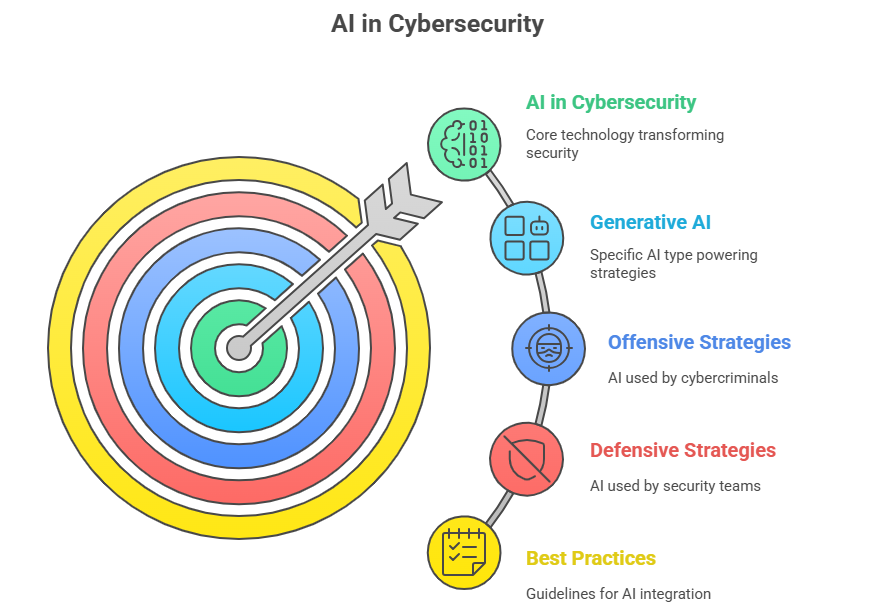
AI technologies, especially generative AI, are now powering both offensive and defensive cybersecurity strategies. While cybercriminals use AI to craft complex attacks, security teams leverage AI-driven tools to anticipate, detect, and neutralize threats before they escalate.
In this article, we explore how generative AI changes cybersecurity, the emerging risks, the tools used to combat them, and best practices for integrating AI into your organization’s security strategy.
Understanding AI in Cybersecurity
AI in cybersecurity is the application of artificial intelligence—including machine learning, deep learning, and generative AI—to detect threats, automate responses, and strengthen overall security posture. Unlike static rule-based systems, AI adapts to new patterns, making it particularly effective against sophisticated attacks.
Key Applications of AI in Cybersecurity
- Threat Detection and Response: AI can monitor network traffic and user behavior in real-time, identifying unusual activity that may indicate a breach.
- Automated Incident Management: Security teams can use AI to automatically respond to threats, such as isolating affected systems or blocking malicious IP addresses.
- Predictive Threat Intelligence: AI analyzes historical data to forecast potential attack vectors, helping organizations proactively strengthen weak points.
- Fraud Detection: AI models detect anomalies in transactions, emails, and login behavior to prevent financial fraud.
Stat Insight: A 2023 Capgemini study found that 69% of organizations view AI as critical for enhancing cybersecurity efficiency and compensating for talent shortages.
Generative AI Threats in Cybersecurity
While AI provides significant benefits, it also introduces new risks. Generative AI threats in cybersecurity are increasingly sophisticated, making it essential for organizations to adapt their defensive strategies.
How Does Generative AI Change Cybersecurity?
Generative AI can mimic human behavior and create content that deceives both systems and users. Its main impact areas include:
- Phishing and Social Engineering: AI-generated messages appear authentic, increasing the likelihood of victims clicking malicious links.
- Malware Generation: Generative AI can produce polymorphic malware capable of bypassing traditional antivirus software.
- Deepfake Fraud: AI-generated audio and video impersonations of executives or employees are used to commit fraud or gain unauthorized access.
- Automated Vulnerability Exploitation: AI can scan systems and identify weaknesses faster than human attackers.
Example: In 2023, a financial services firm reported that AI-generated deepfake audio requests led to a $1.5 million fraud loss before detection.
Additional Insight: According to IBM’s 2024 Cybersecurity Threat Report, 30% of new malware variants are AI-assisted, highlighting the growing role of generative AI in cybercrime.
AI-Driven Threat Detection Cybersecurity Tools
Despite these threats, AI also powers the next generation of AI-driven threat detection cybersecurity tools that help organizations stay ahead of attackers.
Popular AI Cybersecurity Tools and Techniques
- Behavioral Analytics: Monitors user and device behavior to detect anomalies such as unusual login locations or excessive data downloads.
- Network Traffic Analysis: AI algorithms scan network activity in real-time to identify suspicious patterns indicative of cyberattacks.
- Automated Vulnerability Scanning: AI-driven tools continuously scan systems for potential weaknesses, reducing the risk of zero-day exploits.
- Security Orchestration and Automation (SOAR): AI integrates threat intelligence, automates responses, and coordinates multiple security tools for rapid incident management.
- Endpoint Detection and Response (EDR): AI monitors endpoints for malware, ransomware, and suspicious activities, providing instant alerts.
Example: Darktrace’s Enterprise Immune System uses unsupervised machine learning to detect zero-day attacks by analyzing deviations from normal behavior—often before traditional systems recognize threats.
Stat Insight: MarketsandMarkets projects that the AI in cybersecurity market will grow from $14.3 billion in 2024 to $46.3 billion by 2030, highlighting the increasing reliance on AI-driven security solutions.
Advantages of AI in Cybersecurity
Integrating AI into cybersecurity strategies offers several benefits:
- Faster Threat Detection: AI can analyze massive amounts of data instantly, reducing the time between detection and response.
- Reduced Human Error: Automated AI systems reduce mistakes in identifying threats compared to manual processes.
- Scalability: AI solutions can scale to monitor thousands of endpoints and users simultaneously.
- Proactive Defence: Predictive analytics allow organizations to anticipate attacks before they occur.
- Cost Efficiency: AI reduces the operational burden on security teams, lowering overall cybersecurity costs.
Best Practices for Integrating AI into Cybersecurity
To maximize the effectiveness of AI in cybersecurity, organizations should adopt a strategic approach:
- Continuously Train AI Models: Regularly update AI models with the latest threat intelligence to ensure accuracy.
- Combine Human Expertise with AI: Use AI to augment security teams, not replace them, for more nuanced decision-making.
- Implement Multi-Layered Security: Combine AI tools with firewalls, endpoint security, and employee training for comprehensive protection.
- Monitor AI-Generated Alerts: Prioritize alerts with high confidence levels to prevent alert fatigue.
- Audit AI Decisions: Ensure AI actions are explainable and compliant with data protection and cybersecurity regulations.
- Educate Employees: Train staff to recognize AI-enhanced phishing and social engineering attacks.
Pro Tip: AI is most effective when integrated as part of a holistic cybersecurity framework rather than as a standalone solution.
Future of AI in Cybersecurity
The future promises even more integration of AI technologies into cybersecurity frameworks:
- Self-Healing Networks: AI-driven networks that automatically detect, isolate, and remediate attacks.
- Collaborative Threat Intelligence: AI systems sharing anonymized threat data across organizations to prevent attacks.
- Generative AI Defence Models: AI creating countermeasures against AI-powered attacks in real-time.
Insight: Gartner predicts that by 2026, 50% of enterprises will use AI-based cybersecurity solutions for predictive threat detection, emphasizing the shift toward intelligent defense systems.
Conclusion: Embracing AI for a Safer Digital Future
Generative AI is a double-edged sword in cybersecurity. While it introduces new threats like deepfakes and AI-generated malware, it also empowers organizations with faster detection, smarter responses, and predictive defence capabilities.
By understanding how generative AI changes cybersecurity and leveraging AI-driven threat detection cybersecurity tools, businesses can stay ahead of cybercriminals and safeguard critical data.
Explore the latest AI-driven tools at itinsite.in to enhance your cybersecurity strategy today.


Pingback: AI & Innovation Initiatives 2026 | A Powerful Path to Inclusive and Smarter Growth