

By Kaushal Kr Mishra, Cybersecurity | PMP | System Admin | Consultant (20+ Years of Experience) – itinsite.in
In an era where digital transformation and data-driven services are at the forefront of business and everyday life, protecting personal data has become both a legal imperative and a strategic necessity. India’s Digital Personal Data Protection Act, 2023 (commonly referred to as DPDPA) marks a significant milestone in the country’s privacy and data protection journey. This comprehensive guide explores what the Act is, its key provisions, compliance implications for businesses, and best-practices that organisations should adopt now.
Introduction & Background
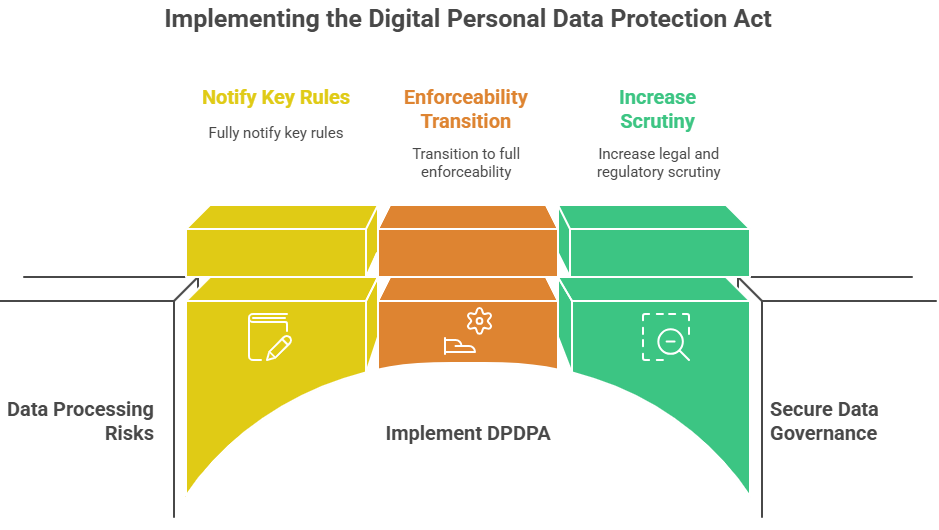
The Digital Personal Data Protection Act, 2023 (DPDPA) was passed by the Indian Parliament in August 2023. (Wikipedia) It is India’s first comprehensive cross-sectoral law targeting the processing of “digital personal data” in a manner that recognises both the right of individuals (data principals) to protect their personal data, and the need of organisations (data fiduciaries) to process such data for lawful purposes. (Wikipedia) Although the Act has been enacted, key rules and commencement notifications are yet to be fully notified, so full enforceability is in a phase of transition. (LinkedIn) From a cybersecurity and system-administration vantage point, the Act signals a shift: data governance, accountability, and security safeguards will be under increasing legal and regulatory scrutiny.
Scope & Key Definitions
What data falls under the Act?
- The Act applies to digital personal data, meaning personal data in digital form (or nondigital form that is subsequently digitised). (Nishith Desai Associates)
- It does not apply to purely nondigitised personal data. (Nishith Desai Associates)
- The Act has extraterritorial application: it applies to processing of digital personal data of individuals in India by entities outside India if goods or services are offered to such individuals. (Nishith Desai Associates)
Who are the key stakeholders?
- Data Principal: The individual whose personal data is processed.
- Data Fiduciary: The entity that determines the purpose and means of processing personal data.
- Data Processor: An entity that processes data on behalf of a data fiduciary.
These definitions mirror similar constructs in global regimes but are tailored to the Indian context. (KPMG Assets)
Key concepts
- Consent: The Act emphasises consent as a key legal basis for processing personal data. (techtarget.com)
- Lawful Purpose: Processing must be for a lawful purpose and consistent with the Act’s obligations. (Thales Cyber Security)
- Special categories / Sensitive data: Unlike some global frameworks, DPDPA does not explicitly carve out separate categories of “sensitive personal data” for heavier regulation, although it still mandates higher attention to risk-based processing. (Wikipedia)
Key Provisions and Obligations
Obligations of Data Fiduciaries
- A data fiduciary must process personal data only for the purposes for which it was collected and only as long as necessary. (Thales Cyber Security)
- It must ensure data minimisation, purpose limitation, accuracy, transparency and security of the personal data. (KPMG Assets)
- The organisation must implement appropriate technical and organisational safeguards to protect against unauthorised or accidental access, disclosure, alteration, destruction or loss of data. (CPO Magazine)
- For “Significant Data Fiduciaries” (SDFs) — those with large scale/sensitive operations — additional obligations apply (e.g., appointment of a Data Protection Officer (DPO), periodic auditing, Data Protection Impact Assessments (DPIAs)). (Legal Service India)
- Organisations must also facilitate the rights of data principals such as access, correction, data portability, erasure. (CPO Magazine)
Rights of Data Principals
Individuals (data principals) have several rights under the Act, including:
- Right to know whether their personal data is being processed and for what purpose.
- Right to correction or erasure of personal data.
- Right to withdraw consent (subject to certain conditions).
- Right to grievance redressal. (CPO Magazine)
Cross-border Data Transfers
The Act allows transfer of personal data outside India, but only to jurisdictions that may be notified by the Central Government (negative list approach) and subject to conditions. (Data Security Council of India (DSCI))
Penalties and Enforcement
Non-compliance attracts significant financial penalties:
- For serious violations by data fiduciaries, penalties can run into ₹250 crore (≈ USD 30 million) or more. (Misut)
- Data fiduciaries must notify the regulator (the Data Protection Board of India) and affected individuals in the event of a data breach. (CPO Magazine)
Why the DPDPA Matters – From a Cybersecurity Perspective
As a cybersecurity professional and system-administrator, your domain is deeply impacted by the DPDPA. Here’s why:
- Elevated risk profile: With heavy penalties and regulatory oversight, data breaches or mis-processing can directly translate into major financial and reputational damage.
- Security controls become compliance controls: Encryption, access management, audit logs, incident response mechanisms now serve both IT/security purposes and regulatory compliance.
- Vendor-/third-party risk & supply-chain: Organisations will be held accountable not just for their data, but also for data processed by third-parties on their behalf. Ensuring vendor compliance is vital.
- Data governance and lifecycle management: It is no longer sufficient to “just secure” data — you must define the purpose, retention period, deletion policy, and audit trails.
- Cross-border operations: If your systems transfer or process personal data across borders (even unintentionally), you must be aware of the Act’s stipulations on international transfers.
- Privacy by Design / Default: As a system administrator/architect, your infrastructure designs must embed privacy and compliance considerations from the outset, not as an after-thought.
Practical Steps for Compliance Roadmap
Whether you are a start-up, SME or large enterprise, here is a practical roadmap of actions to begin with:
Immediate (0-6 months)
- Conduct a data mapping exercise: Catalogue all personal data being collected, processed, stored, shared and disposed.
- Update your privacy policy and consent mechanisms to align with the Act’s language and requirements.
- Review and strengthen security controls: encryption, access controls, logging, incident response.
- Train your staff on data protection responsibilities, breach-response protocols and their roles in compliance.
Medium term (6-12 months)
- Appoint a Data Protection Officer (DPO) if required (or someone responsible for data protection compliance).
- Establish data-retention and deletion policies — minimise data that you retain beyond the purpose for which it was collected.
- Conduct Data Protection Impact Assessments (DPIAs) for high-risk data processing.
- Undertake third-party/vendor audits or due diligence to ensure processors you engage meet requisite safeguards.
Long-term (12+ months)
- Integrate privacy-by-design into projects and system changes.
- Establish continuous monitoring, internal audits, compliance dashboards and governance forums.
- Prepare for cross-border data-transfer regimes and abide by any negative-list jurisdictions or conditions.
- Build strong incident response, breach-notification workflows and documentation ready for regulator engagement.
Key Challenges & Considerations
While the DPDPA is progressive, there are some areas to watch out for:
- Rules yet to be notified: Many detailed provisions — such as exact timelines, definitions of “legitimate use”, conditions for cross-border transfer — are still pending in the subordinate rules. (Nishith Desai Associates)
- Exemptions for government entities: The Act grants broad exemptions to government agencies for certain purposes (state security, public order), which has drawn criticism for potential over-reach. (Legal Service India)
- SME burden: Smaller organisations may find it challenging to meet all the compliance scaffolding and documentation burdens.
- Global comparison: Compared to frameworks like the General Data Protection Regulation (GDPR) in the EU, the DPDPA has its own unique features and differences (for example, in lawful-basis processing). (Wikipedia)
- Operational readiness: Organisations must treat compliance as an operational change — revisiting processes, systems, culture — not just a legal checklist.
What Organisations Should Prioritise
From a practical perspective, here are my top priorities:
- Establish leadership buy-in: Data-protection is now a board-level / C-suite risk. It should be embraced as part of enterprise risk management.
- Embed privacy & security in your architecture: Make sure your systems capture consent, track purpose, support deletion, log access and support audits.
- Vendor/third-party compliance: The weakest link often sits outside your organisation. Strengthen contracts, controls and oversight of processors.
- Incident response readiness: Assume a breach will happen. Have the workflows, forensic capabilities, regulatory notification plan and remediation team ready.
- Operationalise the rights of individuals: You must have processes for access/correction/erasure requests, data-subject rights management, and grievance redressal.
- Continuous training & culture: Regular staff training, phishing simulations, data-handling audits and culture of “privacy by default” are critical.
Summary
The Digital Personal Data Protection Act, 2023 heralds a new era in India’s data protection regime. For organisations, it’s not just a legal checkbox — it’s a strategic imperative for securing trust, managing risk and strengthening data governance. As a cybersecurity & systems professional with over 20 years of experience, I see this as an opportunity: to embed stronger controls, clearer governance and proactive privacy practices that align with business objectives, regulatory expectations and the evolving digital landscape.
Organisations that act early, view compliance as a strategic differentiator, and embed privacy and security as foundational elements will not only reduce risk — they’ll gain competitive advantage by demonstrating trustworthiness to customers, partners and regulators.


Pingback: Key Updates on the DPDPA Guide (Late 2025) – Essential Insights for Data Compliance
Pingback: Chapter VII – Appeal and Alternate Dispute Resolution under the DPDPA Act Explained