
Introduction: Why Dispute Resolution Matters in the Digital Privacy Era
In a digital-first economy, personal data has become one of the most valuable assets. With organizations increasingly collecting, processing, and sharing personal data, disputes between individuals and data-handling entities are no longer rare. When data rights are violated, affected individuals need a clear, reliable, and efficient remedy.
This is where Chapter VII – Appeal and Alternate Dispute Resolution under the DPDPA Act plays a critical role. here is the government outline that you can refer…. https://www.meity.gov.in/content/digital-personal-data-protection-act-2023
Unlike traditional legal frameworks that rely heavily on court litigation, the Digital Personal Data Protection Act (DPDPA Act) introduces a structured, technology-driven grievance redressal mechanism. Chapter VII ensures that disputes related to personal data protection are resolved fairly, transparently, and efficiently, without placing unnecessary burden on the judicial system.
In this guide, you will learn:
- The scope and purpose of Chapter VII of the DPDPA Act
- How the DPDPA appeal process works in practice
- The role of alternate dispute resolution (ADR) under DPDPA Rules
- Practical steps for individuals and organizations
- Compliance strategies to prevent disputes and appeals
Understanding Chapter VII of the DPDPA Act
What Is Chapter VII – Appeal and Alternate Dispute Resolution?
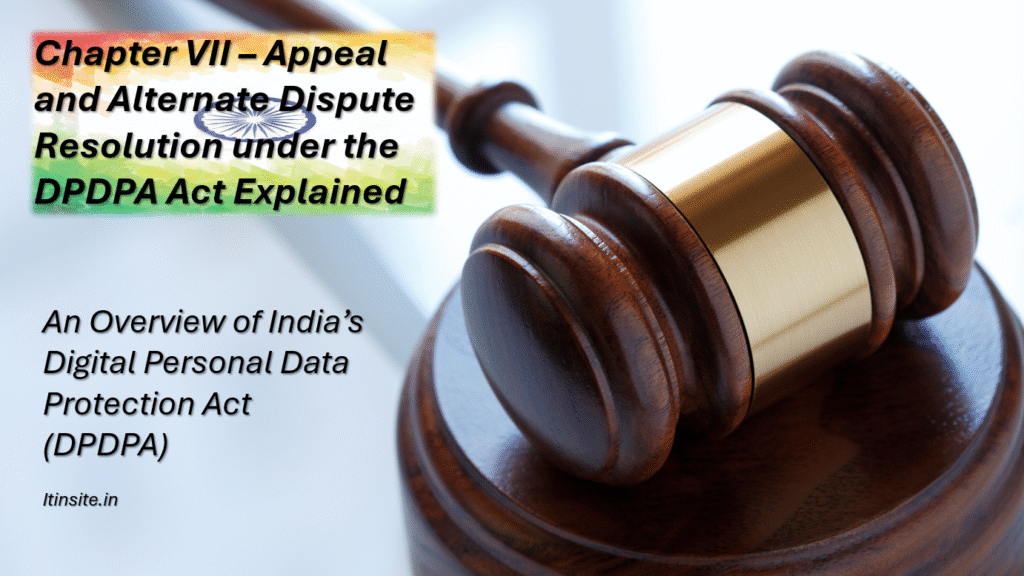
Chapter VII – Appeal and Alternate Dispute Resolution establishes the legal framework for resolving disputes arising under the DPDPA Act. It primarily focuses on two mechanisms:
- Appeals against orders of the Data Protection Board of India
- Alternate dispute resolution mechanisms as an alternative to prolonged litigation
The core objective of Chapter VII is clear:
👉 To provide accessible, efficient, and proportionate remedies for data protection grievances.
This approach aligns with global data protection principles, including those found in the EU’s GDPR, where administrative remedies and mediation are preferred over adversarial court proceedings.
Role of the Data Protection Board of India
Why the Data Protection Board Is Central to Chapter VII
Before an appeal or dispute resolution can arise, it is important to understand the authority whose decisions are being challenged.
The Data Protection Board of India (DPBI) is the primary enforcement and adjudicatory body under the DPDPA Act. Its key functions include:
- Inquiring into complaints related to personal data breaches
- Enforcing compliance with the DPDPA Act and DPDPA Rules
- Issuing directions and imposing penalties on non-compliant Data Fiduciaries
Once the Board issues an order, Chapter VII becomes applicable if any affected party disagrees with the decision.
Appeals Under Chapter VII of the DPDPA Act
Who Can File an Appeal?
Under Chapter VII, the right to appeal is available to:
- A Data Principal, whose personal data rights are affected, or
- A Data Fiduciary or Data Processor, against whom an order has been passed
👉 Only parties directly impacted by a Data Protection Board order may initiate a Data Protection Board appeal.
Where Is the Appeal Filed?
As per Chapter VII of the DPDPA Act:
- Appeals against orders of the Data Protection Board are filed before the Appellate Tribunal notified by the Central Government.
This structure ensures:
- Specialized adjudication of data protection matters
- Faster resolution compared to conventional courts
- Uniform interpretation of the DPDPA Act
Time Limit for Filing an Appeal
Timeliness is a crucial element of the DPDPA appeal process.
Under the DPDPA Rule framework:
- Appeals must be filed within the prescribed statutory period
- Delays may be condoned only if sufficient cause is established
Practical Tip:
Organizations should maintain a data protection compliance calendar to track appeal deadlines and regulatory responses.
Step-by-Step DPDPA Appeal Process
How to File an Appeal Under Chapter VII
Step 1: Review the Board’s Order
Carefully analyze the findings, penalties, or compliance directions.
Step 2: Identify Grounds for Appeal
Common grounds include:
- Errors in factual findings
- Procedural lapses
- Disproportionate penalties
- Incorrect application of DPDPA provisions
Step 3: Prepare the Appeal Application
Include:
- Copy of the Board’s order
- Statement of facts
- Grounds of appeal
- Relief sought
Step 4: Submit to the Appellate Authority
Follow the format and submission process prescribed under DPDPA Rules.
Step 5: Participate in Proceedings
The Appellate Tribunal may conduct hearings or decide based on written records.
Alternate Dispute Resolution (ADR) Under Chapter VII
What Is Alternate Dispute Resolution Under the DPDPA Act?
Alternate Dispute Resolution (ADR) refers to resolving disputes without formal litigation through:
- Mediation
- Conciliation
- Mutually agreed settlements
Chapter VII – Appeal and Alternate Dispute Resolution actively encourages ADR to:
- Reduce litigation costs
- Enable faster dispute resolution
- Promote cooperative compliance
Why ADR Is Important for Data Protection Disputes
Data protection disputes often arise due to:
- Communication gaps
- Operational lapses
- Technical misunderstandings
ADR under the DPDPA Act allows parties to:
- Resolve disputes without reputational harm
- Preserve business and customer relationships
- Achieve balanced and practical outcomes
This approach reflects the digital governance philosophy of the DPDPA framework.
When Can ADR Be Used?
ADR may be adopted:
- Before formal adjudication
- During ongoing proceedings, with consent
- When suggested by the Board or Appellate Authority
Example:
If a data deletion request is delayed, the issue may be resolved through mediation instead of penalties, with commitments to improve compliance processes.
Practical Examples of Chapter VII in Action
Example 1: Appeal by a Data Principal
A customer files a complaint alleging unauthorized data sharing.
The Data Protection Board dismisses the complaint due to insufficient evidence.
➡ The customer files an appeal under Chapter VII of the DPDPA Act, submitting additional digital records.
Outcome:
The Appellate Authority orders a fresh review of the case.
Example 2: Corporate ADR Settlement
A startup is penalized for delayed breach notification.
Instead of pursuing prolonged litigation, the parties opt for ADR.
Settlement terms include:
- Reduced penalty
- Mandatory privacy audit
- Employee data protection training
This approach saves time, costs, and brand reputation.
Compliance Tips to Avoid Appeals and Disputes
For Organizations and Data Fiduciaries
- Establish effective grievance redressal mechanisms
- Maintain accurate consent and processing records
- Respond to Data Principal requests within statutory timelines
- Conduct regular DPDPA compliance audits
- Train teams on DPDPA Rules and obligations
For Individuals (Data Principals)
- Maintain records of data-related requests
- Use internal grievance mechanisms before escalation
- Understand rights under the DPDPA Act
- Escalate responsibly when remedies fail
Why Chapter VII – Appeal and Alternate Dispute Resolution Matters
From an SEO and compliance perspective, Chapter VII – Appeal and Alternate Dispute Resolution is a high-intent legal topic. Searches such as:
- DPDPA appeal process
- Data Protection Board appeal
- DPDPA Act dispute resolution mechanism
are commonly made by legal professionals, compliance officers, and businesses. Publishing authoritative content on this topic strengthens itinsite.in’s credibility in Indian data protection law.
Conclusion: Chapter VII as the Backbone of DPDPA Enforcement
Chapter VII – Appeal and Alternate Dispute Resolution under the DPDPA Act ensures that data protection enforcement remains fair, balanced, and effective. It protects individual rights while giving organizations structured remedies and opportunities for compliance.
By combining appeals with alternate dispute resolution, the DPDPA Act builds trust, accountability, and resilience in India’s digital ecosystem.
👉 Stay informed. Stay compliant. Stay protected.
For authoritative insights on the DPDPA Act, DPDPA Rules, and data protection compliance, continue following itinsite.in—your trusted source for digital law and governance updates.