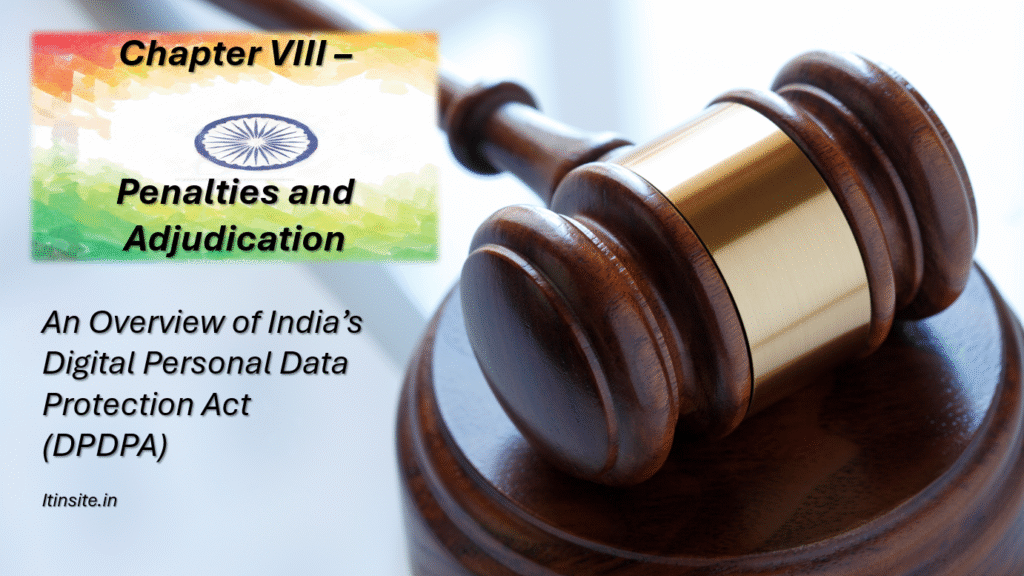

Introduction: Why Penalties Decide the Real Impact of Any Law
A law without enforcement is merely a guideline. What gives real power to legislation is penalties and adjudication—the mechanisms that ensure compliance and accountability.
India’s Digital Personal Data Protection Act (DPDPA Act) is no exception. While most discussions focus on consent, data fiduciaries, or data principal rights, Chapter VIII – Penalties and Adjudication is where the Act truly shows its teeth.
For organizations handling personal data, this chapter defines:
- What happens when things go wrong
- Who decides the consequences
- How severe the financial and regulatory impact can be
In this detailed guide for itinsite.in readers, we break down Chapter VIII in plain language, explain its practical implications, and offer step-by-step compliance guidance to help you stay on the right side of the law.
Understanding Chapter VIII – Penalties and Adjudication (Overview)
Chapter VIII of the DPDPA Act establishes:
- The framework for monetary penalties
- The role of the Data Protection Board of India
- The process of adjudication
- Factors considered while imposing penalties
Unlike earlier Indian IT laws, this chapter emphasizes proportionate punishment, accountability, and corrective action rather than criminal prosecution.
What Is the Purpose of Chapter VIII Under the DPDPA Act?
The primary objectives of Chapter VIII – Penalties and Adjudication are:
- Ensuring compliance with DPDPA Rules
- Protecting data principals from misuse of personal data
- Creating a credible deterrent against negligence
- Encouraging self-correction and responsible data governance
This approach aligns India with global data protection regimes while keeping enforcement business-friendly.
Who Enforces Penalties Under Chapter VIII?
Role of the Data Protection Board of India
The Data Protection Board of India (DPB) is the central adjudicating authority under Chapter VIII.
Key responsibilities include:
- Inquiring into complaints of non-compliance
- Determining whether a violation of the DPDPA Act or DPDPA Rule has occurred
- Imposing penalties based on severity
- Issuing corrective directions
Unlike courts, the Board functions as a specialized regulatory body, ensuring faster and technically informed decisions.
Types of Violations Covered Under Chapter VIII
Chapter VIII does not punish every mistake. It focuses on material violations that harm data principals or undermine trust.
Common Violations Include:
- Failure to implement reasonable security safeguards
- Breach notification failures
- Non-compliance with consent requirements
- Ignoring data principal rights
- Processing children’s data unlawfully
- Repeated violations of DPDPA Rules
Penalty Structure Under Chapter VIII – Explained Simply
Maximum Penalties Under the DPDPA Act
Penalties are civil and monetary, not criminal. Depending on the nature of the violation, fines can go up to:
- ₹250 Crore for serious breaches
- Lower penalties for procedural or first-time lapses
The law deliberately avoids rigid slabs, giving flexibility to the adjudicating authority.
How Are Penalties Determined? (Key Factors)
Factors Considered by the Data Protection Board
Under Chapter VIII – Penalties and Adjudication, the Board evaluates:
- Nature and gravity of the breach
- Duration of non-compliance
- Type and volume of personal data involved
- Impact on data principals
- Whether the breach was intentional or negligent
- Steps taken to mitigate harm
This ensures fairness and proportionality, especially for startups and MSMEs.
Adjudication Process Under Chapter VIII (Step-by-Step)
Step 1: Complaint or Reference
A complaint may be filed by:
- A data principal
- The Central Government
- The Board itself (suo motu)
Step 2: Notice to the Data Fiduciary
The organization is given:
- A chance to respond
- Time to submit evidence or explanations
Step 3: Inquiry and Hearing
The Board may:
- Seek documents
- Conduct hearings
- Request expert opinions
Step 4: Order and Penalty
If violation is established:
- Penalty is imposed
- Corrective actions may be directed
This transparent process reinforces procedural fairness.
How Chapter VIII Differs from Earlier IT Act Penalties
| Aspect | IT Act, 2000 | DPDPA Act (Chapter VIII) |
| Nature | Criminal + Civil | Civil Only |
| Authority | Courts | Data Protection Board |
| Focus | Punishment | Compliance & Correction |
| Flexibility | Limited | High |
This shift reflects modern regulatory thinking.
Practical Examples of Chapter VIII in Action
Example 1: Data Breach Without Safeguards
A fintech company fails to encrypt customer data and suffers a breach.
Outcome:
Penalty imposed due to inadequate safeguards and delayed notification.
Example 2: Ignoring Data Principal Rights
An e-commerce platform ignores deletion requests.
Outcome:
Moderate penalty and directive to update grievance mechanisms.
Compliance Tips to Avoid Penalties Under Chapter VIII
- Conduct Regular Data Audits
Map what data you collect, store, and process.
- Implement Reasonable Security Safeguards
Encryption, access controls, and breach response plans are essential.
- Document Consent and Processing Activities
Clear records help during adjudication.
- Train Employees on DPDPA Rules
Human error is a leading cause of violations.
- Appoint a Grievance Officer
Prompt responses reduce escalation risk.
Why Chapter VIII Matters for Businesses and Professionals
Whether you are:
- A startup founder
- Compliance officer
- IT consultant
- Legal professional
Understanding Chapter VIII – Penalties and Adjudication is critical because:
- Penalties impact financial stability
- Orders affect reputation and operations
- Compliance builds customer trust
Inbound and Outbound Resources
- Learn more DPDPA insights at 👉 https://itinsite.in
- Ministry of Electronics and IT (MeitY) – Official guidance https://www.meity.gov.in
- India Code – Text of the DPDPA Act https://www.indiacode.nic.in
Conclusion: Penalties Are Preventable, Compliance Is Strategic
Chapter VIII – Penalties and Adjudication under the DPDPA Act is not designed to scare businesses—it is designed to discipline data governance in India.
Organizations that:
- Respect personal data
- Follow DPDPA Rules
- Act transparently
will rarely face penalties. Those that ignore compliance will find this chapter costly.
If you want practical DPDPA compliance guides, real-world interpretations, and actionable checklists, explore more expert content on 👉 itinsite.in.
Start compliance today—because prevention is always cheaper than penalties.